The short version
For most UK kitchens: a waterborne acrylic or urethane-acrylic cupboard paint in satin or eggshell, over a primer matched to the surface. Bonding primer for laminate, vinyl wrap and old gloss; stain-blocking primer for oak and pine; a sealer or MDF primer for raw MDF. Allow about two weeks for the paint to cure before heavy use.
Topcoat types compared
Labels in UK shops use names like "cupboard paint", "furniture paint", "satinwood", "eggshell", "trim enamel" and "chalk paint". The resin inside matters more than the name. Read the data sheet, usually linked on the product page, for the binder type, recoat time and cure time.
| Type | Strengths | Weak points | Typical recoat / cure at 20 °C |
|---|---|---|---|
| Waterborne acrylic or urethane-acrylic cupboard paint | Low odour, fast drying, stays white, cleans up in water, sprays well | Soft for the first one to two weeks; short open time shows brush marks if overworked | 2 to 6 hours / about 14 days |
| Waterborne alkyd hybrid (water-based "satinwood") | Flows out more like oil, good levelling, low odour | Slower recoat than pure acrylic; quality varies a lot | 4 to 16 hours / 14 to 21 days |
| Solvent-based (oil) eggshell or satinwood | Excellent flow and hardness once cured | Strong odour, white yellows over time, slow drying, solvent clean-up | 16 to 24 hours / 21 to 28 days |
| Chalk or mineral paint, waxed or lacquered | Good grip with little prep, easy distressed look | Needs a sealer or lacquer to survive a kitchen; wax marks with grease | 1 to 2 hours / depends on topcoat |
| Two-pack (2K) polyurethane or catalysed lacquer | Hardest, most chemical-resistant, the "factory" finish | Trade only; isocyanate or acid-catalyst hazards; needs a booth and air-fed mask | Minutes to hours / days |
| Wall emulsion | Cheap | Not for cupboards: soft, blocks (sticks), marks easily | Not recommended |
For a home project, a waterborne cupboard paint is the default. It is the easiest to apply well and the least likely to yellow. Oil-based paint still has fans for its flow, but most UK trade decorators now use waterborne systems indoors.
Primers by surface
Primer is where most painted kitchens fail. A good topcoat over the wrong primer will peel off in strips.
| Surface | How to recognise it | Primer type | Prep notes |
|---|---|---|---|
| Raw MDF | Brown-grey, fibrous edges, no coating | MDF primer, acrylic sealer or sanding sealer | Edges soak up paint: prime twice and sand between |
| Factory-painted or lacquered MDF | Smooth painted feel, no wrap lip | Bonding primer, or self-priming cupboard paint if the data sheet allows | Tape test first; key with 180 to 240 |
| Vinyl wrap (foil) on MDF | Plastic skin wrapping round the front edge, lip on the back | Bonding primer designed for plastics or "tricky surfaces" | Only if fully stuck; key with 240 by hand |
| Laminate or melamine | Hard, cold, very flat, separate edge strip | Bonding primer for laminate | Key with 180 to 240; degrease very well |
| High-gloss acrylic | Mirror-like, very hard | Bonding primer; test adhesion | Key thoroughly until no gloss remains |
| Oak, ash or other open grain | Visible grain pores, tannin smell when sanded | Stain-blocking primer (shellac or solvent-based is most reliable) | Grain filler if you want no grain showing |
| Pine with knots | Yellow wood, dark round knots | Knotting solution on knots, then stain-blocking primer | Spot-treat knots before full primer |
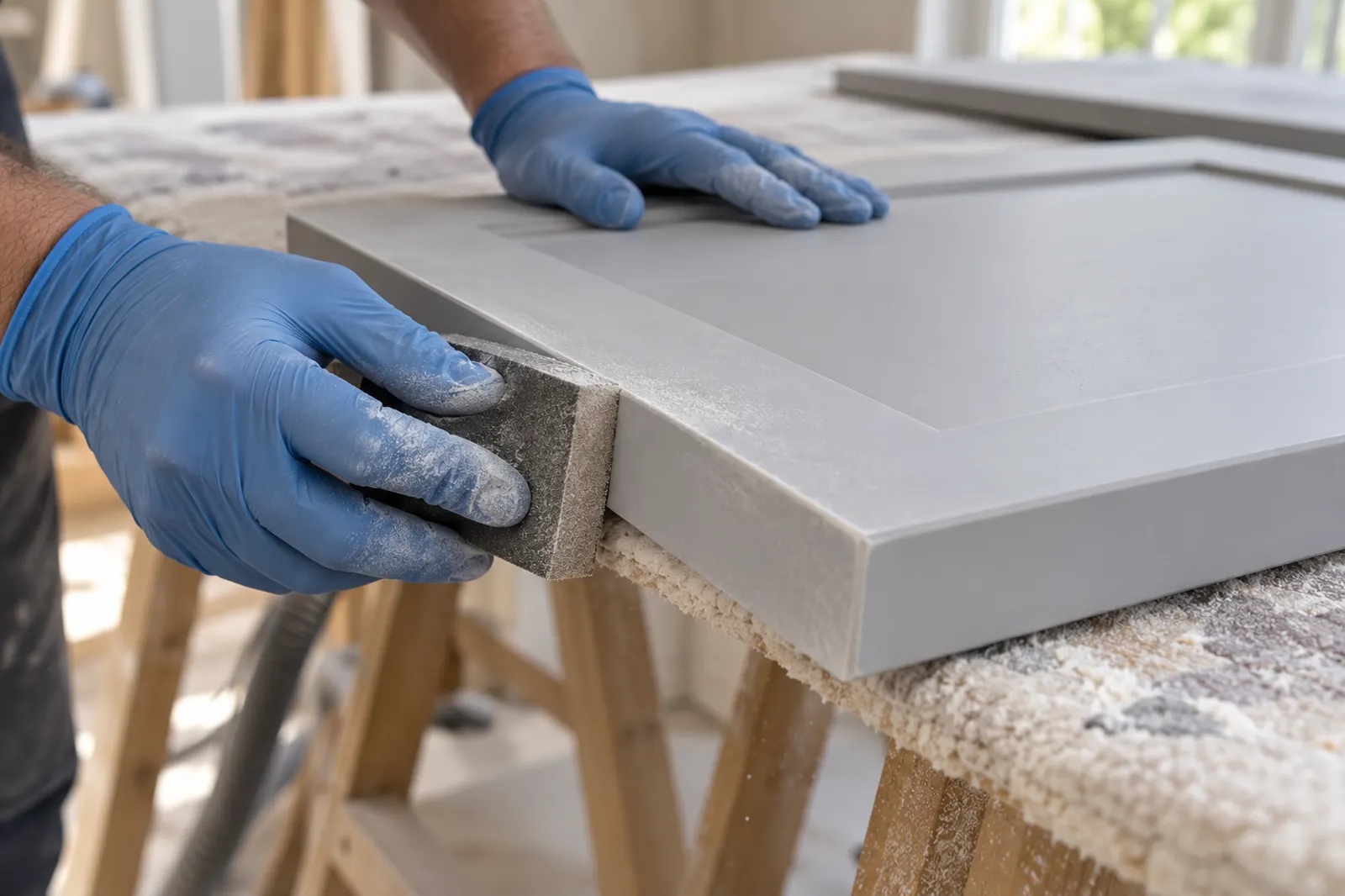
Vinyl wrap: paint it or peel it?
Vinyl-wrapped (also called foil or thermoformed) doors are very common in UK kitchens from the 1990s onwards. They can be painted, but only if the wrap is firmly bonded across the whole door.
- Firmly stuck everywhere: degrease, hand-sand with 240 grit, bonding primer, then topcoat. Avoid heat guns and very hot cloths, which can lift the wrap.
- Lifting near the oven or kettle: the heat has broken the glue. Paint will not hold it down. Peel the wrap off the whole door, usually easier with gentle heat, then sand off glue residue, seal the bare MDF and prime.
- Bubbles in the middle: the same problem; the wrap must come off.
Removing wrap adds an hour or more per door in DIY time, and professional sprayers often charge extra per door for it. If most of the doors are lifting, compare with new doors on the respray vs replace calculator.
Oak and pine: stopping bleed-through
Oak contains tannins, and pine knots contain resin. Both can migrate through waterborne primer and paint, leaving yellow or brown patches days or weeks later, especially on white or pale colours. Waterborne "stain-block" primers help, but shellac-based or solvent-based stain-blocking primers are the most reliable fix.
Oak also has open grain. Paint follows the grain, so a painted oak door still looks like oak in a new colour. If you want a smooth modern finish, fill the grain with a grain filler or fine surface filler, sand flat, then prime. That adds a full stage, so budget a day or more for a kitchen.
Choosing a sheen
- Matthides dents, can polish up
- Eggshellsoft, wipeable
- Satinthe usual kitchen choice
- Glosstoughest, shows every flaw
Sheen is measured as gloss level at 60 degrees. Manufacturers use different words for similar levels, so read the gloss percentage on the data sheet where given. As a rough guide:
- Matt (under about 10%) hides surface flaws, looks soft and modern, but some matt paints burnish to a shine where hands touch them. Choose one sold as scrubbable for kitchens.
- Eggshell (about 10 to 25%) is the common UK compromise: low sheen, wipeable.
- Satin (about 25 to 45%) is tougher to clean and still forgiving. Most painted kitchens use satin or eggshell.
- Gloss (70% or more) is the most durable but shows every dent, ripple and brush mark. It suits sprayed slab doors on very flat surfaces.
Drying vs curing
"Touch dry" means the surface will not mark under a light touch. "Recoat" means another coat can go on without lifting the first. "Cured" means the film has finished hardening. These are very different times, and treating dry paint as cured is the most common reason new paint chips.
| Product type | Touch dry | Recoat | Handle and rehang | Full cure |
|---|---|---|---|---|
| Waterborne primer | About 1 hour | 2 to 4 hours | n/a | n/a |
| Shellac-based primer | 15 to 20 minutes | About 45 minutes | n/a | n/a |
| Waterborne cupboard paint | About 1 hour | 4 to 6 hours | About 24 hours | About 14 days |
| Oil-based satinwood | 4 to 6 hours | 16 to 24 hours | About 48 hours | 21 to 28 days |
Cold slows everything down. A rough rule used in the planner is that every 10 °C drop doubles the time. At 10 °C, a waterborne paint that recoats in 4 hours at 20 °C needs about 8 hours. High humidity slows waterborne paint more than oil. Most waterborne paints should not be applied below 10 °C at all. Use the drying planner to build a schedule for your room.
Two tests before you buy
The tape test for existing paint
Clean a small area, cut a small cross-hatch through the paint with a craft knife (six cuts each way, about 2 mm apart), press a strip of masking tape firmly over it and rip it off. If more than a few squares come away, the existing paint is not sound enough to paint over.
The sample door
Prep, prime and paint the back of one door, or a door from a utility cupboard, first. Leave it a week. Try to scratch it with a fingernail, wipe it with a damp cloth and kitchen spray, and stick tape to it. If it passes, do the rest.
Questions
What is the best type of paint for kitchen cupboards?
For most UK kitchens, a waterborne cupboard or trim paint based on acrylic or urethane-modified acrylic resin, in satin or eggshell, over a primer suited to the door surface. It dries quickly, does not yellow and cures hard enough for daily use.
Can I use wall paint on kitchen cupboards?
No. Wall emulsion is softer, marks easily and stays slightly tacky, so doors stick and edges chip. Use a paint sold for wood, trim, furniture or kitchen units.
Do I need a primer on kitchen cupboards?
Almost always. Laminate, vinyl wrap and gloss paint need a bonding primer; oak and knotty pine need a stain-blocking primer; raw MDF needs sealing. Some cupboard paints are self-priming on previously painted surfaces only.
What is the difference between dry and cured paint?
Dry means the solvent or water has left and the surface can be touched. Cured means the film has finished hardening. Waterborne cupboard paints are often touch dry in an hour but take around two weeks to cure; oil-based paints take longer.
Next: follow the twelve-step method, or work out quantities with the paint calculator.