The short version
For a home kitchen, a 230 V turbine HVLP sprayer with a 1.5 to 2.0 mm needle is usually the right buy: little overspray, easy to control on doors, and fine with waterborne cupboard paint thinned 5 to 15%. Airless is faster but wastes more paint and needs a fine-finish tip of about 210 to 310. Either way, prep and a dust-free booth matter more than the gun.
Is spraying worth it for your kitchen?
Spraying pays off on flat slab doors and gloss or satin finishes, where brush and roller texture shows most. On shaker doors in matt or eggshell, a careful roller finish is close enough that many people skip the sprayer. Spraying also suits you if you have somewhere to build a booth: a garage, a cleared spare room or a dry outbuilding. Without one, you will spend more time masking than spraying.
It does not suit doors that are failing. Swollen MDF, peeling wrap or broken hinge holes need fixing or replacing first. The respray or replace calculator compares the routes for your number of doors.
HVLP, airless or a compressor gun
Three kinds of sprayer are sold for furniture and cabinets in the UK. They break paint into droplets in different ways, which changes how much reaches the door and how much drifts round the room.
| Turbine HVLP | Airless | Compressor-fed HVLP or LVLP | |
|---|---|---|---|
| How it works | Lots of low-pressure air from a turbine | Paint pumped at high pressure through a tiny tip | Compressed air turned down at the gun |
| Typical UK price, 2026 | £70 to £150 DIY; £400 to £1,000 trade | £150 to £400 DIY; £800+ trade | £60 to £300 for the gun, plus a compressor |
| Paint that reaches the door | Roughly 65% or more | Roughly 50% | Good with a well-set gun |
| Overspray | Low | Higher; fine mist travels | Low to medium |
| Paint lost per session | A cupful | About 0.3 to 0.5 L in the pump and hose | A cupful |
| Best for | Doors, drawers, furniture | Big batches, carcasses, walls | Workshops with a large compressor |
The percentages are working rules used by finishers, not lab figures for any model. They are why the paint calculator adds about 35% for HVLP and 60% plus a priming loss for airless. A compressor gun needs more air than most 24 or 50 litre DIY compressors give, so check the litres per minute the gun asks for. UK sprayers are 230 V with a standard three-pin plug, or 110 V on building sites; the 120 V US models seen in many tutorials are not for UK sockets.
Cans instead of a sprayer? Aerosols are fine for a handful of small pieces. A whole kitchen needs ten or more cans per coat, the film is thin and soft, and the cost soon passes an entry-level HVLP.
Needles, tips and thinning
Thin waterborne cupboard paint only enough to spray well. Too thick gives orange peel; too thin gives runs and poor cover. Start from your paint's data sheet, which often gives a maximum thinning figure for spraying.
| Coating | HVLP needle | Airless tip | Typical thinning |
|---|---|---|---|
| Waterborne primer or undercoat | 1.8 to 2.2 mm | 310 to 415 | 5 to 10% water |
| Waterborne acrylic or urethane-acrylic topcoat | 1.5 to 2.0 mm | 210 to 312 fine finish | 5 to 15% water |
| Shellac-based primer | 1.3 to 1.5 mm | Not usually airless at home | Usually none |
| Oil-based satinwood or eggshell | 1.5 to 1.8 mm | 210 to 310 | Up to 10% white spirit if allowed |
Airless tip numbers give fan width and hole size: a 210 tip throws roughly a 10 inch fan (double the first digit) from a 0.010 inch hole. Narrow fans of 4 to 6 inches suit doors best.
Quick check without a viscosity cup: lift a stirrer out of the thinned paint. It should run off in a steady thin stream that breaks into drips after a second or two. Then spray a piece of card. The edges of the pattern should be soft and even, with no heavy stripe in the middle and no spitting at the ends.
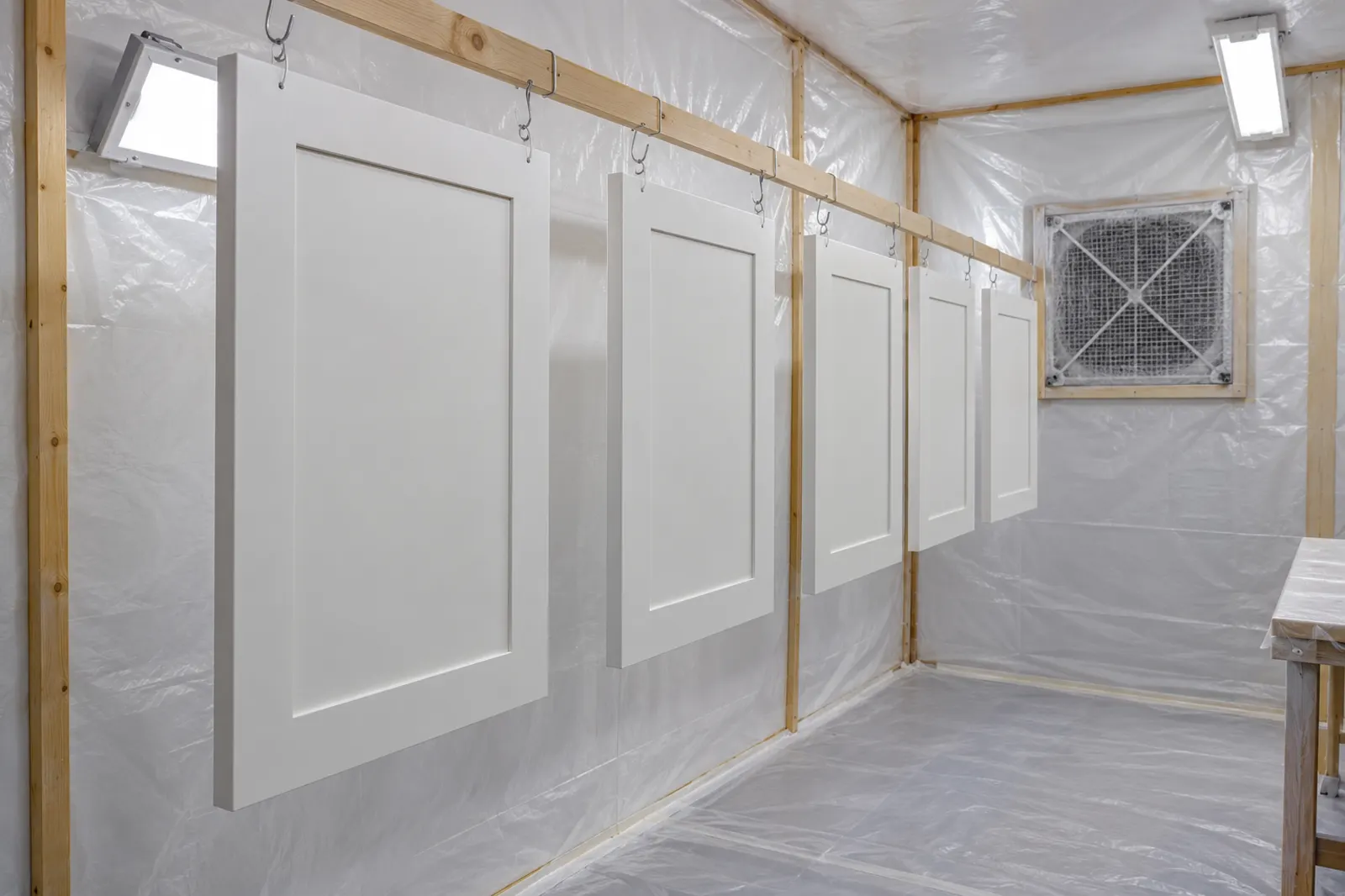
Chapter 1
Build the booth
Battens, polythene, side light and air moving out through a filter.
The booth keeps mist in, dust off and lets you see the wet edge. Allow about two hours in a garage or emptied spare room.
- Frame and sheet it. Roof battens or a pop-up frame with 125 to 250 micron polythene stapled over, floor included. Aim for at least 2 × 2.5 m so you can walk round a hanging door.
- Move air out through a filter. A box fan blowing outside through a paint-arrest filter pulls mist away from you. Leave a filtered gap on the far side so the booth does not suck dust in round the edges. Never use a fan with exposed brushes or a heater with solvent coatings.
- Light it from the side. Two LED work lights at a low angle show the wet edge and any dry patches. Overhead light hides faults until the paint dries.
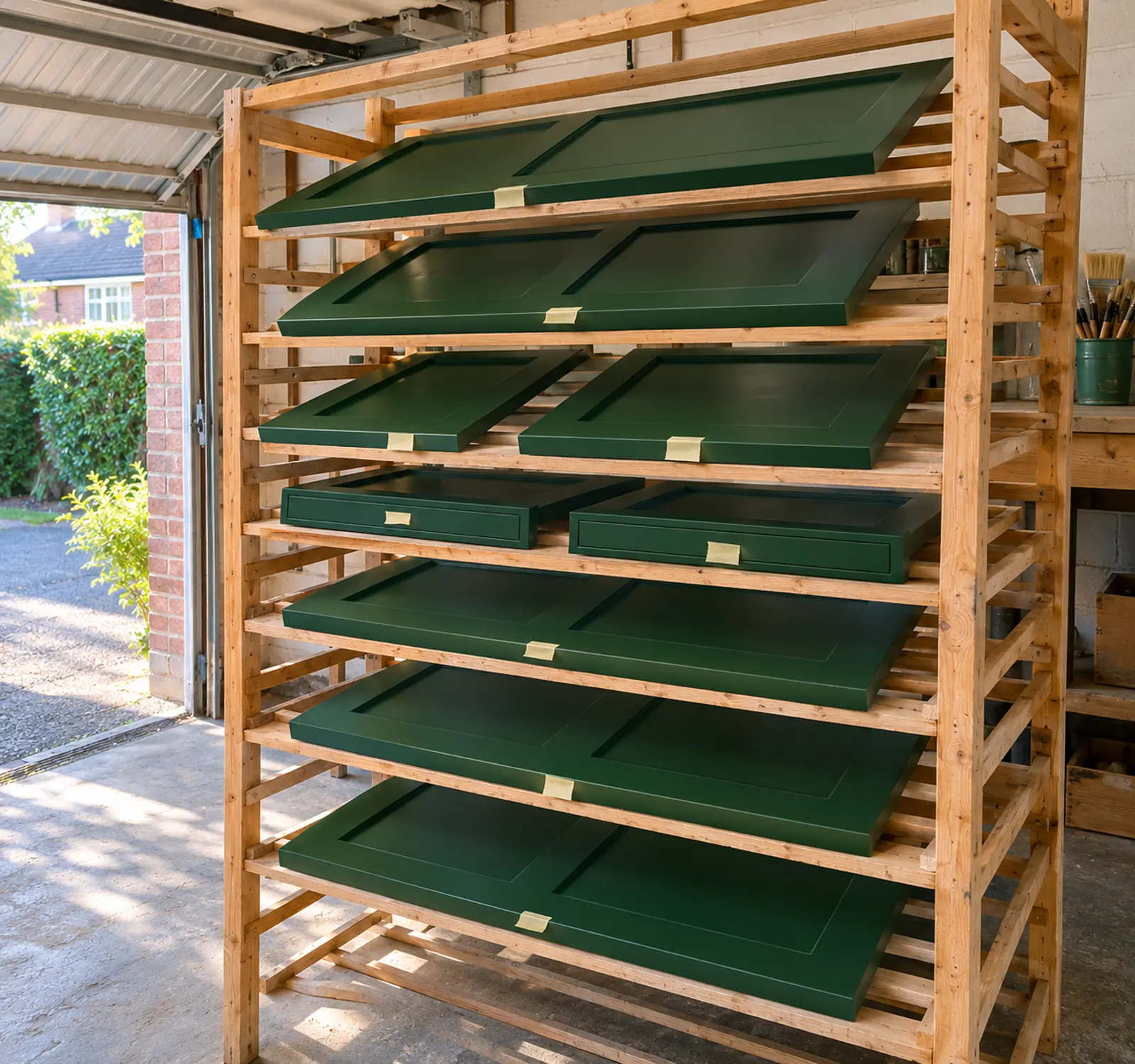
- Hang or rack the doors. A cup hook in a hinge hole lets you hang doors from a rail and spray both faces and every edge in one go. Laying them flat on pyramids is easier on runs but needs a flip.
- Settle the dust. Mist the floor sheet lightly with water and close the booth for 20 minutes. Keep it above 15 °C: most waterborne paints must not go on below 10 °C.
Gun technique, in four short chapters
Practise on cardboard or a spare door first. Ten minutes of practice saves hours of sanding out runs.
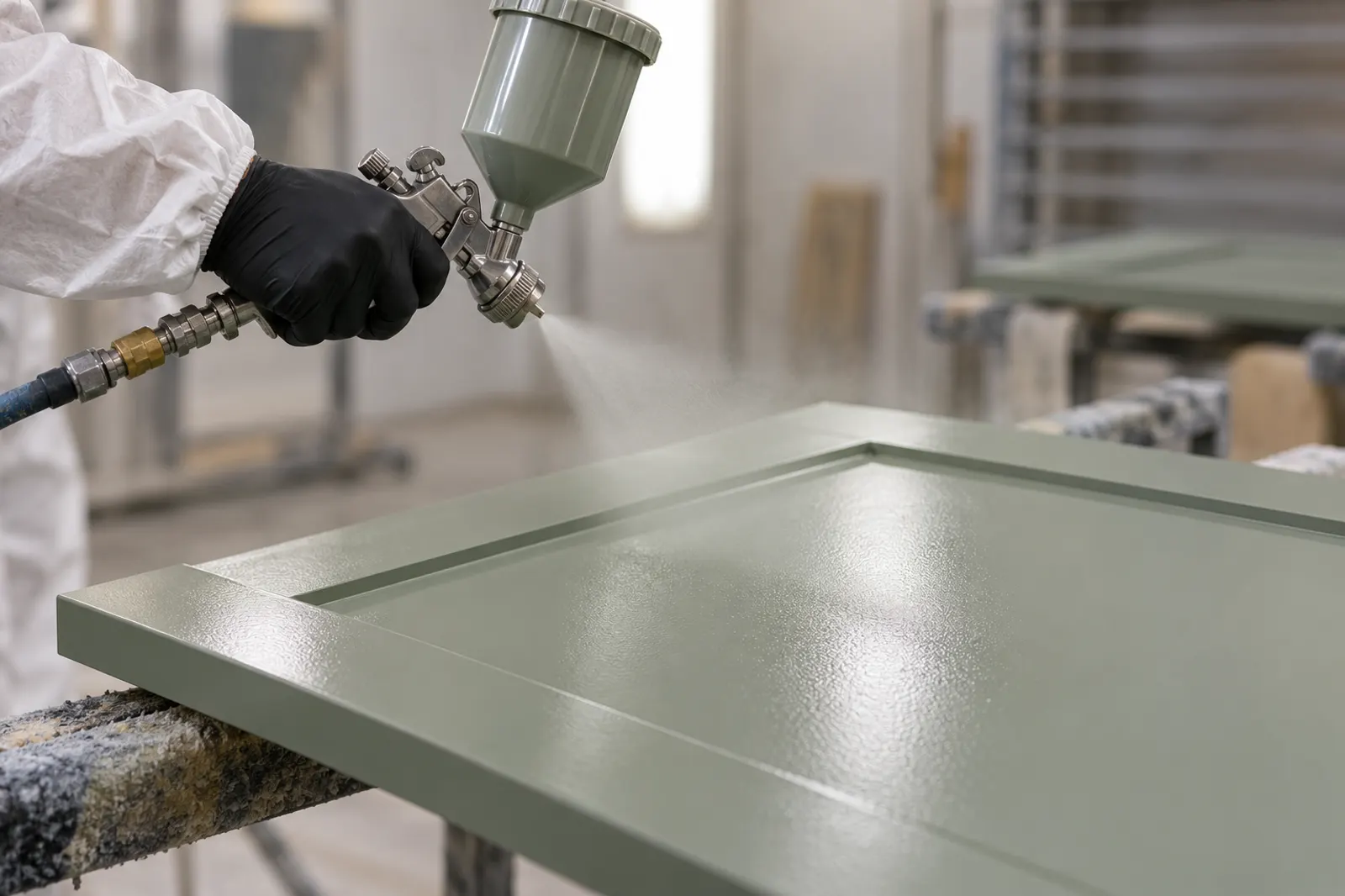
Chapter 2
Set the fan and flow
One pass, one even wet stripe. No more.
Prep the doors
Remove, label, degrease, fill and sand exactly as in the cupboard painting guide. Spraying shows poor prep more, not less.
Build and clean the booth
See chapter 1 above. Wipe the hanging rail and hooks too, because dust falls from them onto wet doors.
Thin and test
Thin within the data sheet limit, strain the paint into the cup and spray card until the pattern is even.
Set the fan and flow
Start with the fluid dial low and open it until one pass on card gives a wet, even line that does not run. Set the fan to about the width of a door rail, roughly 15 cm.
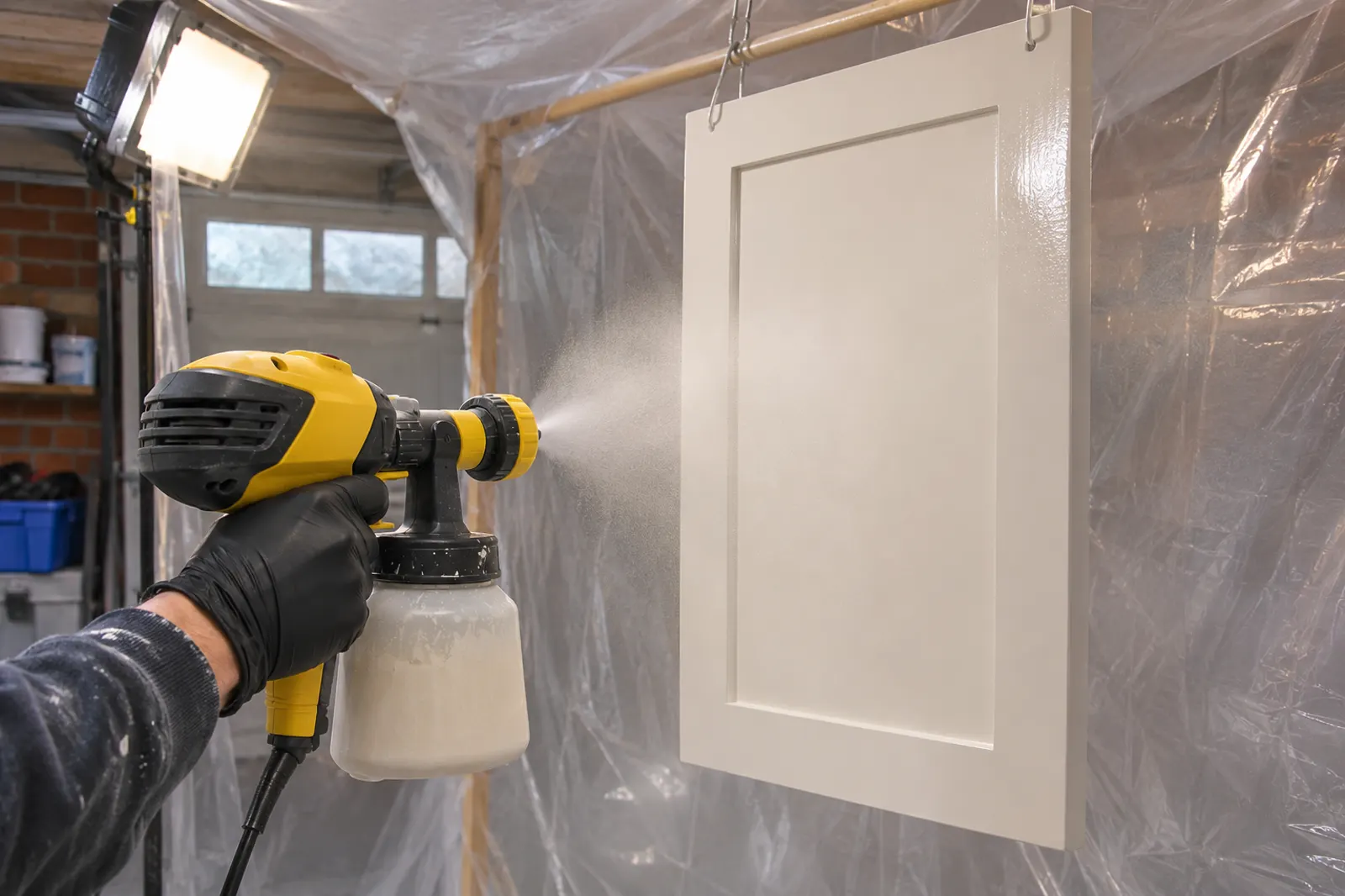
Chapter 3
Edges first, then faces
Gun square, 15 to 20 cm away, moving before the trigger.
Spray edges, then faces
Hold an HVLP gun 15 to 20 cm from the door, or an airless gun 25 to 30 cm, and keep it square: tilting puts a heavy stripe down one side. Spray the four edges with a quick pass, then any profiles on shaker doors, then the flat panel. Overspray from the panel then lands on wet edges instead of dry ones, which avoids a rough band. Start moving before you pull the trigger, keep moving after you let go, and overlap each pass by about half.
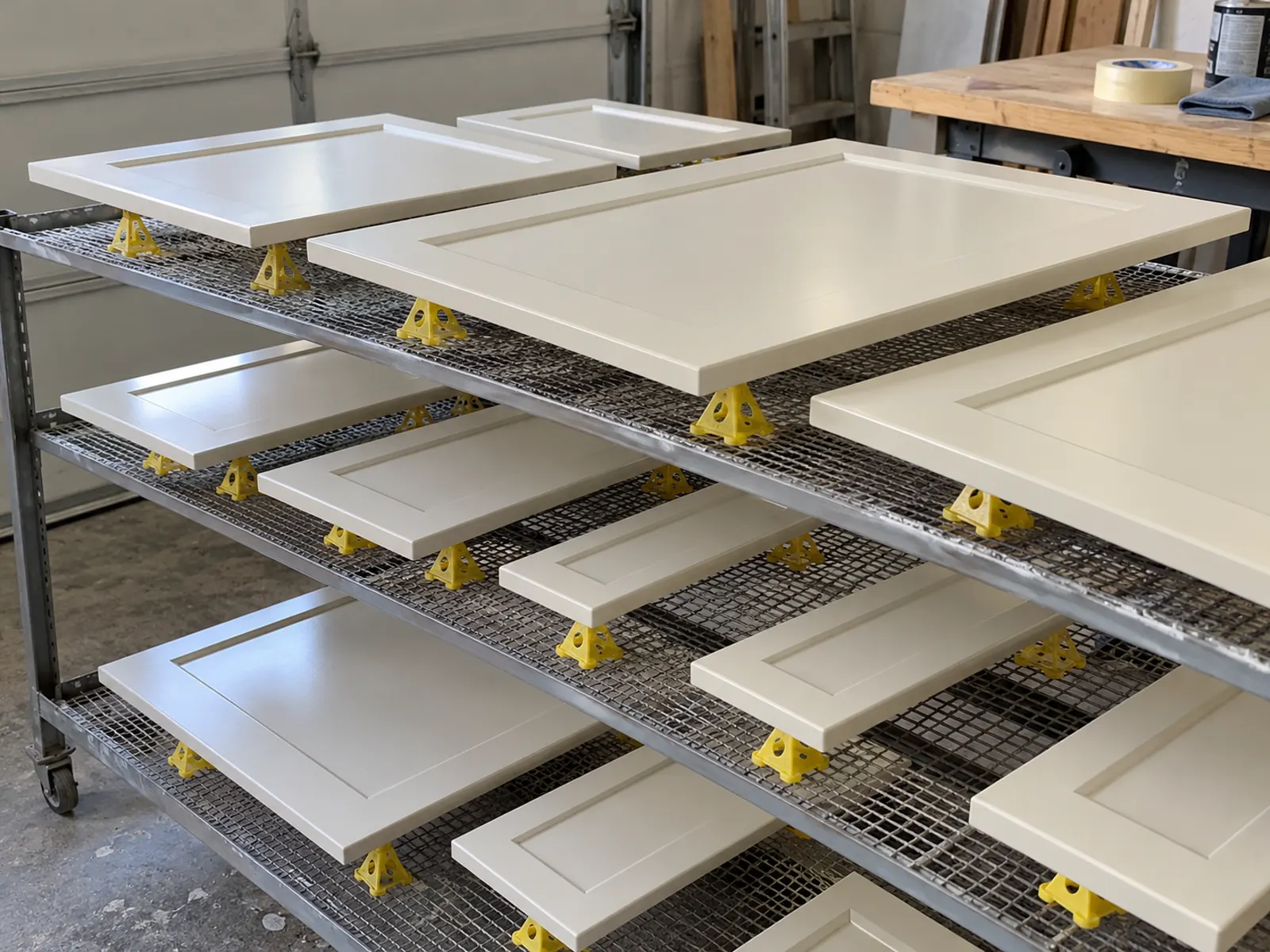
Chapter 4
Read the wet surface
Evenly wet with a slight sheen means stop.
Check against the light
Look across the wet door at a low angle. It should be evenly wet with a slight sheen. Dry, sandy patches need one more light pass; a sagging line means too much paint, so stop and leave it. A run can be sanded flat once fully dry.
Recoat and denib
Wait the full recoat time on the tin, often 2 to 4 hours for sprayed waterborne paint at 20 °C. Feel for nibs and take them off with a very fine pad, wipe, and spray the second coat the same way. The drying planner gives a dated timetable.
Chapter 5
Clean up the same day
Doors dry; the gun gets cleaned now, not tomorrow.
Clean the gun the same day
Flush waterborne paint through with warm water until it runs clear, then take off the air cap and needle and clean them. Paint that dries in the passages makes the gun spit next time. Airless pumps usually need a storage fluid if left for more than a few days; follow the maker's instructions.
Spraying cabinets without removing them
You can spray carcasses and even doors in place, and professionals often spray carcasses on site. For DIY it is the hardest version of the job. Everything in the room needs covering: worktops, floor, walls, ceiling, appliances, the hob and every socket, with film and paper taped edge to edge. Turn off and cover any gas appliance and keep the room ventilated to outside.
A practical split for most homes: spray the doors and drawer fronts in a booth, and brush or roll the fixed face frames, end panels and plinths. The difference is hard to see once doors are hung, because the doors are what you look at.
What spraying costs: DIY against a professional
Typical 2026 figures for a 20-front MDF kitchen in sound condition, outside London. Your own numbers come from the respray or replace calculator.
| DIY spray | Professional respray | |
|---|---|---|
| Typical total | £310 to £760 including an entry sprayer | £900 to £1,700 |
| Coating | Waterborne one-pack cupboard paint | Usually two-pack or catalysed, harder |
| Your time | Two to three weekends | Clearing the kitchen; job takes 2 to 6 working days |
| Risk | Runs, dust, a learning curve on the first doors | Choosing a sprayer whose prep matches the price |
| Guarantee | None | Often several years, in writing |
Professional spray painting of kitchen cabinets is priced per door or per front. Published guides in October 2026 put a typical kitchen at £800 to £1,600, with standard fronts from about £80 each when priced singly. See kitchen respraying cost for what a quote should include.
Five tutorials worth watching
Four are from US channels, so the method transfers but the product names do not. Each has a note on what to copy and what to change for UK materials.
Copy: how much masking and prep a whole-kitchen job takes, and a realistic look at an airless sprayer used indoors.
UK notes: the 120 V airless unit has 230 V UK equivalents. On a 15 to 20 door kitchen, the paint lost filling an airless pump is a real share of the total, which is why many UK DIYers pick HVLP.
Video by Golden Key Design. Open it on YouTube. Nothing loads from YouTube until you press play; the player then comes from youtube-nocookie.com.
Copy: a tidy order of work and the hook-and-rail method for spraying both faces without touching the door.
UK notes: the primer and paint are US brands. Use a UK waterborne cupboard paint and a primer for your surface. A US drop cloth is a dust sheet.
Video by Lowe's Home Improvement. Open it on YouTube. Nothing loads from YouTube until you press play; the player then comes from youtube-nocookie.com.
Copy: grain filling on oak, softening sharp edges, caulking the panel joint and one-third overlapping passes.
UK notes: he uses solvent-borne trade lacquers. Without an extracted booth, waterborne primer and topcoat are safer at home. 40 psi is about 2.8 bar.
Video by The Handyman. Open it on YouTube. Nothing loads from YouTube until you press play; the player then comes from youtube-nocookie.com.
Copy: a short, honest look at a handheld airless sprayer on cabinets at home, useful for judging fan size and pass speed.
UK notes: if you buy a handheld airless here, check it takes fine-finish tips. The general-purpose tips on cheap units are too coarse for doors.
Video by DIY Auto And Home. Open it on YouTube. Nothing loads from YouTube until you press play; the player then comes from youtube-nocookie.com.
Copy: a clear walk round a gravity-fed HVLP gun: fan direction, fluid and pattern knobs, and a full strip-down clean.
UK notes: the gun runs from a large compressor. Most UK home users will be better served by a 230 V turbine HVLP that needs no compressor.
Video by SALVAGED by k. scott. Open it on YouTube. Nothing loads from YouTube until you press play; the player then comes from youtube-nocookie.com.
Safety: what is in the mist
Waterborne cupboard paints are low in solvent, but spray mist is still fine paint you should not breathe. Wear a half-mask respirator with combined filters (A2P3 is common), eye protection and a disposable coverall, and keep children and pets out until the air is clear.
Solvent-based coatings bring a fire risk too. Keep pilot lights, boilers and any spark out of the spray area, and lay solvent-soaked rags flat outside to dry before binning them.
Colours that date, and colours that last
People often ask which cabinet colours will look dated by the end of 2026. Interior writers this year are steering away from cool blue-greys and stark brilliant white towards warmer off-whites, putty, mushroom and muted greens, and some now call deep forest green and navy overdone. Survey data says otherwise for now: the Houzz UK 2026 kitchen trends survey found blue and green were the most chosen cabinet colours among renovating homeowners. The practical answer: pick a colour you like in your own light, and spray a sample board before committing.
Questions
Can you paint cabinets with spray paint?
Yes. A sprayer gives the smoothest DIY finish on doors. Aerosol cans also work on a few small pieces, but a whole kitchen needs ten or more cans per coat and the finish is softer than a proper cupboard paint, so for a full kitchen an HVLP sprayer is cheaper and tougher.
What is the best paint for spraying kitchen cabinets in the UK?
For home spraying, a waterborne acrylic or urethane-modified cupboard or trim paint that the maker says can be sprayed, over a primer chosen for the door surface. Professionals use two-pack or catalysed coatings, which are not suitable for home spraying. More in best paint for kitchen cupboards.
Can I spray kitchen cabinets without sanding?
Not safely. Spray paint is thin and has nothing to hold on a glossy or greasy door. Degrease and give every surface a light sand with 180 to 240 grit, even when using a bonding primer.
How long does it take to spray a kitchen?
For 15 to 20 doors, allow about two weekends: one for removal, cleaning, sanding and priming, and one for two topcoats and rehanging, plus a day for the booth. The spraying itself is quick; prep and drying take the time.
Can you spray kitchen cabinets in place?
Yes, but the whole room has to be sealed in film and paper and the overspray risk is high. Most DIYers spray doors in a booth and brush or roll the fixed carcasses. On-site spraying of carcasses is common for professionals.
Next: count litres and tins with the paint calculator, or go back to the twelve-step painting method for prep.